The city is a major centre of art, technology, finance, publishing, culture, innovation, education, business, and tourism in Germany and Europe and enjoys a very high standard and quality of living, reaching first in Germany and fourth worldwide according to the
2015 Mercer survey.
[5] According to the
Globalization and World Rankings Research Institute Munich is considered an
alpha-world city, as of 2015.
[6]
The name of the city is derived from the
Old/
Middle High German term
Munichen, meaning "by the monks". It derives from the monks of the
Benedictine order, who ran a monastery at the place that was later to become the Old Town of Munich; hence the monk depicted on
the city's coat of arms. Munich was first mentioned in 1158. Catholic Munich was a cultural stronghold of the
Counter-Reformation and a political point of divergence during the resulting
Thirty Years' War, but remained physically untouched despite an occupation by the Protestant
Swedes.
[7][citation needed] Once Bavaria was established as
a sovereign kingdom in 1806, it became a major European centre of arts, architecture, culture and science. In 1918, during the
German Revolution, the ruling
house of Wittelsbach, which governed Bavaria since 1180, was forced to abdicate in Munich and a short-lived
socialist republic was declared.
In the 1920s, Munich became home to several political factions, among them the
NSDAP. The first attempt of the Nazi movement to take over the German government in 1923 with the
Beer Hall Putsch was stopped by the Bavarian police in Munich with gunfire. After the Nazis' rise to power, Munich was declared their "Capital of the Movement". During World War II, Munich was heavily bombed and more than 50% of the entire city and up to 90% of the historic centre were destroyed. After the end of postwar American occupation in 1949, there was a great increase in population and economic power during the years of
Wirtschaftswunder, or "economic miracle". Unlike many other German cities which were heavily bombed and destroyed, Munich restored most of its traditional cityscape and hosted the
1972 Summer Olympics. The 1980s brought strong economic growth, high-tech industries and scientific institutions, and population growth. The city is home to major corporations like
BMW,
Siemens,
MAN,
Linde,
Allianz and
MunichRE.
Munich is home to many universities, museums and theatres. Its numerous architectural attractions, sports events, exhibitions and its annual
Oktoberfest attract considerable
tourism.
[8] Munich is one of the most prosperous and fastest growing cities in Germany. It is a top-ranked destination for migration and expatriate location, despite being the municipality with the highest population density in Germany (4,500 people per km²) . Munich hosts more than 530,000 people of foreign background, making up 37.7% of its population.
[9]
History[edit]
Origin as medieval town[edit]

Munich in the 16th century
Duke
Louis IV, a native of Munich, was elected German king in 1314 and crowned as
Holy Roman Emperor in 1328. He strengthened the city's position by granting it the salt monopoly, thus assuring it of additional income. In the late 15th century, Munich underwent a revival of
gothic arts: the Old Town Hall was enlarged, and Munich's largest
gothic church – the
Frauenkirche – now a cathedral, was constructed in only 20 years, starting in 1468.
Capital of reunited Bavaria[edit]

Banners with the colours of Munich (left) and Bavaria (right) with the
Frauenkirche in the background
In 1806, the city became the capital of the new
Kingdom of Bavaria, with the state's parliament (the
Landtag) and the new
archdiocese of Munich and Freising being located in the city. Twenty years later,
Landshut University was moved to Munich. Many of the city's finest buildings belong to this period and were built under the first three Bavarian kings. Especially
Ludwig I rendered outstanding services to Munich's status as a centre of the arts, attracting numerous artists and enhancing the city's architectural substance with grand boulevards and buildings. On the other hand,
Ludwig II, famous the world over as the fairytale king, was mostly aloof from his capital and focused more on his fanciful castles in the Bavarian countryside. Nevertheless, his patronage of Richard Wagner secured his posthumous reputation, as do his castles, which generate significant tourist income for Bavaria to this day. Later, Prince Regent
Luitpold's years as regent were marked by tremendous artistic and cultural activity in Munich, enhancing its status as a cultural force of global importance (see
Franz von Stuck and
Der Blaue Reiter).
World War I to World War II[edit]
Following the outbreak of World War I in 1914, life in Munich became very difficult, as the Allied blockade of Germany led to food and fuel shortages. During French air raids in 1916, three bombs fell on Munich.
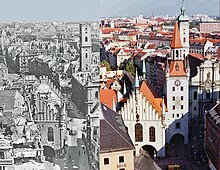
Bombing damage to the Altstadt. Note the roofless and pockmarked Altes Rathaus looking up the Tal. The roofless Heilig-Geist-Kirche is on the right of the photo. Its spire, without the copper top, is behind the church. The Talbruck gate tower is missing completely.
In 1923, Adolf Hitler and his supporters, who were concentrated in Munich, staged the
Beer Hall Putsch, an attempt to overthrow the
Weimar Republic and seize power. The revolt failed, resulting in Hitler's arrest and the temporary crippling of the
Nazi Party (NSDAP), which was virtually unknown outside Munich. The city again became a Nazi stronghold when the party took power in Germany in 1933. The party created its first
concentration camp at
Dachau, 16 kilometres (9.9 miles) north-west of the city. Because of its importance to the rise of National Socialism, Munich was referred to as the
Hauptstadt der Bewegung ("Capital of the Movement"). The NSDAP headquarters were in Munich and many
Führerbauten ("
Führer-buildings") were built around the
Königsplatz, some of which still survive.
The city is known as the site of the culmination of the policy of
appeasement by Britain and France leading up to World War II. It was in Munich that British Prime Minister
Neville Chamberlain assented to the annexation of Czechoslovakia's Sudetenland region into Greater Germany in the hopes of sating the desires of Hitler's
Third Reich.
The city was heavily damaged by allied bombing during World War II – it was hit by 71 air raids during five years.
Postwar[edit]
After US occupation in 1945, Munich was completely rebuilt following a meticulous and – by comparison to other war-ravaged
West German cities
[citation needed] – rather conservative plan which preserved its pre-war street grid. In 1957, Munich's population surpassed 1 million. The city continued to play a highly significant role in the German economy, politics and culture, giving rise to its nickname
Heimliche Hauptstadt ("secret capital") in the decades after World War II.
Most Munich residents enjoy a high quality of life. Mercer HR Consulting consistently rates the city among the top 10 cities with the highest quality of life worldwide – a 2011 survey ranked Munich as 4th.
[11] The same company also ranks Munich as the 39th most expensive in the world and most expensive major city in Germany.
[12] Munich enjoys a thriving economy, driven by the information technology, biotechnology, and publishing sectors. Environmental pollution is low, although as of 2006 the city council is concerned about levels of
particulate matter (PM), especially along the city's major thoroughfares. Since the enactment of
EU legislation concerning the concentration of particulate in the air, environmental groups such as
Greenpeace have staged large protest rallies to urge the city council and the State government to take a harder stance on pollution.
[13] Today, the crime rate is low compared with other large German cities, such as
Hamburg or
Berlin. For its high quality of life and safety, the city has been nicknamed "Toytown"
[14] among the English-speaking residents. German inhabitants call it "Millionendorf", an expression which means "village of a million people". Due to the high standard of living in and the thriving economy of the city and the region, there was an influx of people and Munich's population surpassed 1.5 million by June 2015, an increase of more than 20% in 10 years.
Geography[edit]
Munich lies on the elevated plains of
Upper Bavaria, about 50 km (31.07 mi) north of the northern edge of the
Alps, at an altitude of about 520 m (1,706.04 ft)
ASL. The local rivers are the
Isar and the
Würm. Munich is situated in the Northern
Alpine Foreland. The northern part of this sandy plateau includes a highly fertile
flint area which is no longer affected by the
folding processes found in the Alps, while the southern part is covered with
morainic hills. Between these are fields of
fluvio-glacial out-wash, such as around Munich. Wherever these deposits get thinner, the
ground water can permeate the gravel surface and flood the area, leading to
marshes as in the north of Munich.
Climate[edit]
Showers and thunderstorms bring the highest average monthly precipitation in late spring and throughout the summer. The most precipitation occurs in June, on average. Winter tends to have less precipitation, the least in February.
The higher elevation and proximity to the Alps cause the city to have more rain and snow than many other parts of Germany. The Alps affect the city's climate in other ways too; for example, the warm downhill wind from the Alps (
föhn wind), which can raise temperatures sharply within a few hours even in the winter.
Being at the centre of Europe, Munich is subject to many climatic influences, so that weather conditions there are more variable than in other European cities, especially those further west and south of the Alps.
At Munich's official weather station, the highest and lowest temperatures ever measured are 37 °C (99 °F), on 13 August 2003, and −31.6 °C (−24.9 °F), on 12 February 1929.
| [hide]Climate data for Munich City 1981–2010 (extremes 1954–present) |
|---|
| Month | Jan | Feb | Mar | Apr | May | Jun | Jul | Aug | Sep | Oct | Nov | Dec | Year |
|---|
| Record high °C (°F) | 18.9
(66) | 21.4
(70.5) | 24.0
(75.2) | 32.2
(90) | 31.8
(89.2) | 35.2
(95.4) | 37.5
(99.5) | 37.0
(98.6) | 31.8
(89.2) | 28.2
(82.8) | 24.2
(75.6) | 21.7
(71.1) | 37.5
(99.5) |
|---|
| Average high °C (°F) | 3.5
(38.3) | 5.0
(41) | 9.5
(49.1) | 14.2
(57.6) | 19.1
(66.4) | 21.9
(71.4) | 24.4
(75.9) | 23.9
(75) | 19.4
(66.9) | 14.3
(57.7) | 7.7
(45.9) | 4.2
(39.6) | 13.9
(57) |
|---|
| Daily mean °C (°F) | 0.3
(32.5) | 1.4
(34.5) | 5.3
(41.5) | 9.4
(48.9) | 14.3
(57.7) | 17.2
(63) | 19.4
(66.9) | 18.9
(66) | 14.7
(58.5) | 10.1
(50.2) | 4.4
(39.9) | 1.3
(34.3) | 9.7
(49.5) |
|---|
| Average low °C (°F) | −2.5
(27.5) | −1.9
(28.6) | 1.6
(34.9) | 4.9
(40.8) | 9.4
(48.9) | 12.5
(54.5) | 14.5
(58.1) | 14.2
(57.6) | 10.5
(50.9) | 6.6
(43.9) | 1.7
(35.1) | −1.2
(29.8) | 5.9
(42.6) |
|---|
| Record low °C (°F) | −22.2
(−8) | −25.4
(−13.7) | −16.0
(3.2) | −6.0
(21.2) | −2.3
(27.9) | 1.0
(33.8) | 6.5
(43.7) | 4.8
(40.6) | 0.6
(33.1) | −4.5
(23.9) | −11.0
(12.2) | −20.7
(−5.3) | −25.4
(−13.7) |
|---|
| Average precipitation mm (inches) | 48
(1.89) | 46
(1.81) | 65
(2.56) | 65
(2.56) | 101
(3.98) | 118
(4.65) | 122
(4.8) | 115
(4.53) | 75
(2.95) | 65
(2.56) | 61
(2.4) | 65
(2.56) | 944
(37.17) |
|---|
| Mean monthly sunshine hours | 79 | 96 | 133 | 170 | 209 | 210 | 238 | 220 | 163 | 125 | 75 | 59 | 1,777 |
|---|
| Source #1: Data derived from "CDC (Climate Data Center)". Deutscher Wetterdienst. Retrieved 2 May 2016. |
| Source #2: Extremes: "Monatsauswertung". sklima.de (in German). SKlima. Retrieved 2 May 2016. |
|
| [show]Climate data for Munich Airport (1971–2000) |
|---|
|
Demographics[edit]
| Historical population |
|---|
| Year | Pop. | ±% |
|---|
| 1500 | 13,447 | — |
|---|
| 1600 | 21,943 | +63.2% |
|---|
| 1750 | 32,000 | +45.8% |
|---|
| 1880 | 230,023 | +618.8% |
|---|
| 1890 | 349,024 | +51.7% |
|---|
| 1900 | 499,932 | +43.2% |
|---|
| 1910 | 596,467 | +19.3% |
|---|
| 1920 | 666,000 | +11.7% |
|---|
| 1930 | 728,900 | +9.4% |
|---|
| 1940 | 834,500 | +14.5% |
|---|
| 1950 | 823,892 | −1.3% |
|---|
| 1960 | 1,055,457 | +28.1% |
|---|
| 1970 | 1,311,978 | +24.3% |
|---|
| 1980 | 1,298,941 | −1.0% |
|---|
| 1990 | 1,229,026 | −5.4% |
|---|
| 2000 | 1,210,223 | −1.5% |
|---|
| 2005 | 1,259,584 | +4.1% |
|---|
| 2010 | 1,353,186 | +7.4% |
|---|
| 2011 | 1,364,920 | +0.9% |
|---|
| 2012 | 1,388,308 | +1.7% |
|---|
| 2013 | 1,402,455 | +1.0% |
|---|
| 2015 | 1,450,381 | +3.4% |
|---|
From only 24,000 inhabitants in 1700, the city population doubled about every 30 years. It was 100,000 in 1852, 250,000 in 1883 and 500,000 in 1901. Since then, Munich has become Germany's third largest city. In 1933, 840,901 inhabitants were counted, and in 1957 over 1 million.
Immigration[edit]
![[icon]](https://upload.wikimedia.org/wikipedia/commons/thumb/1/1c/Wiki_letter_w_cropped.svg/20px-Wiki_letter_w_cropped.svg.png) |
This section needs expansion. You can help by adding to it. (June 2017)
|
In July 2017, Munich had 1.42 million inhabitants; 300,129 of those did not have
German citizenship. The city has strong
Turkish and
Balkan communities. The largest groups of foreign nationals were
Turks (39,204),
Croats (33,177),
Italians (27,340),
Greeks (27,117),
Polish (27,945),
Austrians (21,944), and
Romanians (18,085). 37% of foreign nationals come from the
European Union.
The 15 largest foreign resident groups by 31.12.2017
 Turkey Turkey | 37,998 |
 Croatia Croatia | 36,655 |
 Italy Italy | 27,060 |
 Greece Greece | 26,360 |
 Austria Austria | 20,990 |
 Poland Poland | 19,456 |
 Bosnia and Herzegovina Bosnia and Herzegovina | 18,987 |
 Romania Romania | 17,415 |
 Serbia Serbia | 13,758 |
 Iraq Iraq | 12,124 |
 Bulgaria Bulgaria | 12,035 |
 Kosovo Kosovo | 11,114 |
 France France | 9,983 |
 Hungary Hungary | 8,621 |
 Spain Spain | 8,614 |
 Russia Russia | 8,603 |
Religion[edit]
An absolute majority of 55.5% of Munich's residents are not affiliated with any religious group, and this ratio represents the fastest growing segment of the population. As in the rest of Germany, the Roman Catholic and Protestant churches have experienced a continuous decline in membership. As of 31 December 2017, 31.8% of the city's inhabitants were
Roman Catholic, 11.4%
Protestant and 0.3%
Jewish.
[15] In 2011, 7.5% were Muslim migrants from 21 countries of origin.
[16] About 1% adhere to other Christian denominations. There is also a small Old Catholic parish and an English-speaking parish of the
Episcopal Church in the city.
Politics[edit]
Munich's current mayor is
Dieter Reiter of the
Social Democratic Party of Germany. Munich has been governed by the SPD for all but six years since 1948. This is remarkable because Bavaria – and particularly southern Bavaria – has long been a conservative stronghold, with the
Christian Social Union winning
absolute majorities among the Bavarian electorate in many elections at the communal, state, and federal levels, and leading the Bavarian state government for all but three years since 1946. Bavaria's second most populous city,
Nuremberg, is also one of the very few Bavarian cities governed by an SPD-led coalition.
As the capital of the Free State of Bavaria, Munich is an important political centre in Germany and the seat of the
Bavarian State Parliament, the Staatskanzlei (the State Chancellery) and of all state departments.
Subdivisions[edit]
Since the administrative reform in 1992, Munich is divided into 25
boroughs or
Stadtbezirke, which themselves consist of sometimes quite distinct smaller quarters.
Allach-Untermenzing (23),
Altstadt-Lehel (1),
Aubing-Lochhausen-Langwied (22),
Au-Haidhausen (5),
Berg am Laim (14),
Bogenhausen (13),
Feldmoching-Hasenbergl (24),
Hadern (20),
Laim (25),
Ludwigsvorstadt-Isarvorstadt (2),
Maxvorstadt (3),
Milbertshofen-Am Hart (11),
Moosach (10),
Neuhausen-Nymphenburg (9),
Obergiesing (17),
Pasing-Obermenzing (21),
Ramersdorf-Perlach (16),
Schwabing-Freimann (12),
Schwabing-West (4),
Schwanthalerhöhe (8),
Sendling (6),
Sendling-Westpark (7),
Thalkirchen-Obersendling-Forstenried-Fürstenried-Solln (19),
Trudering-Riem (15) and
Untergiesing-Harlaching (18).
Architecture[edit]
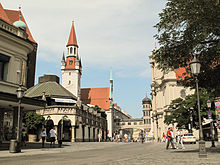
Viktualienmarkt with the Altes Rathaus
The city has an eclectic mix of historic and modern architecture, because historic buildings destroyed in World War II were reconstructed, and new landmarks were constructed. A survey by the Society's Centre for Sustainable Destinations for the
National Geographic Traveller chose over 100 historic destinations around the world and ranked Munich 30th.
[17]
Inner city[edit]
The
Peterskirche close to Marienplatz is the oldest church of the inner city. It was first built during the
Romanesque period, and was the focus of the early monastic settlement in Munich before the city's official foundation in 1158. Nearby St. Peter the Gothic hall-church
Heiliggeistkirche (The Church of the Holy Spirit) was converted to baroque style from 1724 onwards and looks down upon the
Viktualienmarkt, the most popular market of Munich.
The large
Residenz palace complex (begun in 1385) on the edge of Munich's Old Town, Germany's largest urban palace, ranks among Europe's most significant museums of interior decoration. Having undergone several extensions, it contains also the
treasury and the splendid rococo
Cuvilliés Theatre. Next door to the Residenz the neo-classical opera, the
National Theatre was erected. Among the baroque and neoclassical mansions which still exist in Munich are the
Palais Porcia, the
Palais Preysing, the
Palais Holnstein and the
Prinz-Carl-Palais. All mansions are situated close to the Residenz, same as the
Alte Hof, a medieval castle and first residence of the Wittelsbach dukes in Munich.
Lehel, a bourgeoise quarter east of the Altstadt, is characterised by countless well-preserved (and in parts excellently reconstructed) town houses, giving a thorough impression of the "old Munich" outside of the main tourist routes.
St. Lukas is the largest Protestant Church in Munich.
The inner city has been recreated
[18] in the virtual world of
Second Life and can be visited for a virtual sight seeing tour.
Royal avenues and squares[edit]
Four grand royal avenues of the 19th century with magnificent official buildings connect Munich's inner city with its then-suburbs:
The neo-Gothic
Maximilianstraße starts at
Max-Joseph-Platz, where the
Residenz and the National Theatre are situated, and runs from west to east. The avenue is framed by elaborately structured neo-Gothic buildings which house, among others, the
Schauspielhaus, the
Building of the district government of Upper Bavaria and the
Museum of Ethnology. After crossing the river Isar, the avenue circles the
Maximilianeum, home of the
state parliament. The western portion of Maximilianstraße is known for its designer shops, luxury boutiques, jewellery stores, and one of Munich's foremost five-star hotels, the
Hotel Vier Jahreszeiten.
Other boroughs[edit]
In
Schwabing and
Maxvorstadt, many beautiful streets with continuous rows of
Gründerzeit buildings can be found. Rows of elegant town houses and spectacular urban palais in many colours, often elaborately decorated with ornamental details on their façades, make up large parts of the areas west of
Leopoldstraße (Schwabing's main shopping street), while in the eastern areas between Leopoldstraße and
Englischer Garten similar buildings alternate with almost rural-looking houses and whimsical mini-castles, often decorated with small towers. Numerous tiny alleys and shady lanes connect the larger streets and little plazas of the area, conveying the legendary artist's quarter's flair and atmosphere convincingly like it was at the turn of the 20th century. The wealthy district of
Bogenhausen in the east of Munich is another little-known area (at least among tourists) rich in extravagant architecture, especially around Prinzregentenstraße. One of Bogenhausen's most beautiful buildings is
Villa Stuck, famed residence of painter
Franz von Stuck.
Two large baroque palaces in
Nymphenburg and
Oberschleissheim are reminders of Bavaria's royal past.
Schloss Nymphenburg (
Nymphenburg Palace), some 6 km (4 mi) north west of the city centre, is surrounded by an impressive park and is considered to be one of Europe's most beautiful royal residences. 2 km (1 mi) northwest of Nymphenburg Palace is
Schloss Blutenburg (
Blutenburg Castle), an old ducal country seat with a late-Gothic palace church.
Schloss Fürstenried (
Fürstenried Palace), a baroque palace of similar structure to Nymphenburg but of much smaller size, was erected around the same time in the south west of Munich. The second large baroque residence is
Schloss Schleissheim (
Schleissheim Palace), located in the suburb of
Oberschleissheim, a palace complex encompassing three separate residences:
Altes Schloss Schleissheim (the old palace),
Neues Schloss Schleissheim (the new palace) and
Schloss Lustheim (Lustheim Palace). Most parts of the palace complex serve as museums and art galleries.
Deutsches Museum's
Flugwerft Schleissheim flight exhibition centre is located nearby, on the Schleissheim Special Landing Field. The
Bavaria statue before the neo-classical
Ruhmeshalle is a monumental, bronze sand-cast 19th-century statue at
Theresienwiese. The
Grünwald castle is the only medieval castle in the Munich area which still exists.
St Michael in Berg am Laim might be the most remarkable church in the suburbs. Another church of
Johann Michael Fischer is
St George in Bogenhausen. Most of the boroughs have parish churches which originate from the Middle Ages like the most famous church of pilgrimage in Munich
St Mary in Ramersdorf. The oldest church within the city borders is
Heilig Kreuz in Fröttmaning next to the Allianz-Arena, known for its Romanesque fresco. Especially in its suburbs, Munich features a wide and diverse array of modern architecture, although strict culturally sensitive height limitations for buildings have limited the construction of skyscrapers to avoid a loss of views to the distant Bavarian Alps. Most high-rise buildings are clustered at the northern edge of Munich in the skyline, like the
Hypo-Haus, the
Arabella High-Rise Building, the
Highlight Towers,
Uptown Munich,
Münchner Tor and the
BMW Headquarters next to the Olympic Park. Several other high-rise buildings are located near the city centre and on the
Siemens campus in southern Munich. A landmark of modern Munich is also the architecture of the sport stadiums (as described
below).

Hofgarten with the dome of the state chancellery near the
Residenz
Munich is a densely-built city but still offers numerous public parks. The
Englischer Garten, close to the city centre and covering an area of 3.7 km
2 (1.4 sq mi) (larger than Central Park in New York), is one of the world's largest urban public parks. It contains a famous
nudist area, numerous bicycle and jogging tracks as well as bridle-paths. It is considered the "green lung" of Munich and one of the city's best-loved features. It was designed and laid out by
Benjamin Thompson, Count of Rumford, for both pleasure and as a work area for the city's vagrants and homeless. Nowadays it is entirely a park, its southern half being dominated by wide and extremely well-kept open areas, hills, monuments and beach-like stretches (along the streams Eisbach and Schwabinger Bach), which get crowded in summer. In contrast, its less-frequented northern part is much more quiet, idyllic and natural-seeming, at times resembling a natural preserve more than an urban public park: it has lots of old trees, thick undergrowth, winding streams, hidden meadows and is pervaded by numerous romantic pathways. Multiple
Biergartens can be found in both parts of the Englischer Garten, the most well known being located at the
Chinese Pagoda.
The city's
zoo is the
Tierpark Hellabrunn near the Flaucher Island in the Isar in the south of the city. Another notable park is
Ostpark located in the
Ramersdorf-Perlach borough which also houses the
Michaelibad, the largest waterpark in Munich.

Olympiasee in Olympiapark, Munich
Basketball[edit]
Ice hockey[edit]
Olympics[edit]
Marathon[edit]
There are three annual road running events in Munich, the
Munich Marathon in October, the company run B2Run in July and the New Year's Run on 31 December.
Swimming[edit]
River surfing[edit]
Munich has a reputation as a surfing hotspot, offering the world's best known
river surfing spot, the
Eisbach wave, which is located at the southern edge of the
Englischer Garten park and used by surfers day and night and throughout the year.
[25] Half a kilometre down the river, there is a second, easier wave for beginners, the so-called
Kleine Eisbachwelle. Two further surf spots within the city are located along the river
Isar, the wave in the Floßlände channel and a wave downstream of the Wittelsbacherbrücke bridge.
[26]
Culture[edit]
Language[edit]
The
Bavarian dialects are spoken in and around Munich, with its variety
Upper Bavarian (
Oberbayrisch). Austro-Bavarian has no official status by the Bavarian authorities or local government, yet is recognised by the
SIL and has its own ISO-639 code.
Museums[edit]
The
Deutsches Museum or German Museum, located on an island in the River Isar, is the largest and one of the oldest science museums in the world. Three redundant exhibition buildings that are under a protection order were converted to house the
Verkehrsmuseum, which houses the land transport collections of the Deutsches Museum. Deutsches Museum's
Flugwerft Schleissheim flight exhibition centre is located nearby, on the Schleissheim Special Landing Field. Several non-centralised museums (many of those are public collections at Ludwig-Maximilians-Universität) show the expanded state collections of
palaeontology, geology,
mineralogy,
[27] zoology, botany and anthropology.
Arts and literature[edit]
The modern
Gasteig centre houses the
Munich Philharmonic Orchestra. The third orchestra in Munich with international importance is the
Bavarian Radio Symphony Orchestra. Its primary concert venue is the
Herkulessaal in the former city royal residence, the
Munich Residenz. Many important conductors have been attracted by the city's orchestras, including
Felix Weingartner,
Hans Pfitzner,
Hans Rosbaud,
Hans Knappertsbusch,
Sergiu Celibidache,
James Levine,
Christian Thielemann,
Lorin Maazel,
Rafael Kubelík,
Eugen Jochum,
Sir Colin Davis,
Mariss Jansons,
Bruno Walter,
Georg Solti,
Zubin Mehta and
Kent Nagano. A stage for shows, big events and musicals is the
Deutsche Theater. It is Germany's largest theatre for guest performances.
Munich's contributions to modern popular music are often overlooked in favour of its strong association with classical music, but they are numerous: the city has had a strong music scene in the 1960s and 1970s, with many internationally renowned bands and musicians frequently performing in its clubs. Furthermore, Munich was the centre of
Krautrock in southern Germany, with many important bands such as
Amon Düül II,
Embryo or
Popol Vuh hailing from the city. In the 1970s, the
Musicland Studios developed into one of the most prominent recording studios in the world, with famous bands such as the
Rolling Stones,
Led Zeppelin,
Deep Purple and
Queen recording albums there. Munich also played a significant role in the development of electronic music, with genre pioneer
Giorgio Moroder, who invented
synth disco and
electronic dance music, and
Donna Summer, one of disco music's most important performers, both living and working in the city. In the late 1990s,
Electroclash was substantially co-invented if not even invented in Munich, when
DJ Hell introduced and assembled international pioneers of this musical genre through his
International DeeJay Gigolo Records label here.
[28] Other examples of notable musicians and bands from Munich are
Konstantin Wecker,
Willy Astor,
Spider Murphy Gang,
Münchener Freiheit,
Lou Bega,
Megaherz,
FSK,
Colour Haze and
Sportfreunde Stiller.
Music is so important in the Bavarian capital that the city hall gives permissions every day to 10 musicians for performing in the streets around Marienplatz. This is how performers such as
Olga Kholodnaya and
Alex Jacobowitz are entertaining the locals and the tourists every day.
The city is known as the second largest publishing centre in the world (around 250 publishing houses have offices in the city), and many national and international publications are published in Munich, such as Arts in Munich, LAXMag and Prinz.
At the turn of the 20th century, Munich, and especially its suburb of
Schwabing, was the preeminent cultural metropolis of Germany. Its importance as a centre for both literature and the fine arts was second to none in Europe, with numerous German and non-German artists moving there. For example,
Wassily Kandinsky chose Munich over Paris to study at the
Akademie der Bildenden Künste München, and, along with many other painters and writers living in Schwabing at that time, had a profound influence on
modern art.
Prominent literary figures worked in Munich especially during the final decades of the Kingdom of Bavaria, the so-called
Prinzregentenzeit (literally "prince regent's time") under the reign of
Luitpold, Prince Regent of Bavaria, a period often described as a cultural Golden Age for both Munich and Bavaria as a whole. Among them were luminaries such as
Thomas Mann,
Heinrich Mann,
Paul Heyse,
Rainer Maria Rilke,
Ludwig Thoma,
Fanny zu Reventlow,
Oskar Panizza,
Gustav Meyrink,
Max Halbe,
Erich Mühsam and
Frank Wedekind. For a short while, even
Vladimir Lenin lived in Schwabing, where he wrote and published his most important work,
What Is to Be Done? Central to Schwabing's bohemian scene (although they were actually often located in the nearby Maxvorstadt quarter) were
Künstlerlokale (artist's cafés) like
Café Stefanie or Kabarett
Simpl, whose liberal ways differed fundamentally from Munich's more traditional localities. The
Simpl, which survives to this day (although with little relevance to the city's contemporary art scene), was named after Munich's famous anti-authoritarian satirical magazine
Simplicissimus, founded in 1896 by
Albert Langen and
Thomas Theodor Heine, which quickly became an important organ of the
Schwabinger Bohème. Its strikingly modern caricatures and biting satirical attacks on
Wilhelmine German society were the result of countless of collaborative efforts by many of the best visual artists and writers from Munich and elsewhere.
The period immediately before World War I saw continued economic and cultural prominence for the city.
Thomas Mann wrote somewhat ironically in his novella
Gladius Dei about this period: "München leuchtete" (literally "Munich shone"). Munich remained a centre of cultural life during the Weimar period, with figures such as
Lion Feuchtwanger,
Bertolt Brecht,
Peter Paul Althaus,
Stefan George,
Ricarda Huch,
Joachim Ringelnatz,
Oskar Maria Graf,
Annette Kolb,
Ernst Toller,
Hugo Ball and
Klaus Mann adding to the already established big names.
Karl Valentin was Germany's most important cabaret performer and comedian and is to this day well-remembered and beloved as a
cultural icon of his hometown. Between 1910 and 1940, he wrote and performed in many absurdist sketches and short films that were highly influential, earning him the nickname of "Charlie Chaplin of Germany". Many of Valentin's works wouldn't be imaginable without his congenial female partner
Liesl Karlstadt, who often played male characters to hilarious effect in their sketches. After World War II, Munich soon again became a focal point of the German literary scene and remains so to this day, with writers as diverse as
Wolfgang Koeppen,
Erich Kästner,
Eugen Roth,
Alfred Andersch,
Elfriede Jelinek,
Hans Magnus Enzensberger,
Michael Ende,
Franz Xaver Kroetz,
Gerhard Polt,
John Vincent Palatine and
Patrick Süskind calling the city their home.
From the Gothic to the Baroque era, the fine arts were represented in Munich by artists like
Erasmus Grasser,
Jan Polack,
Johann Baptist Straub,
Ignaz Günther,
Hans Krumpper,
Ludwig von Schwanthaler,
Cosmas Damian Asam,
Egid Quirin Asam,
Johann Baptist Zimmermann,
Johann Michael Fischer and
François de Cuvilliés. Munich had already become an important place for painters like
Carl Rottmann,
Lovis Corinth,
Wilhelm von Kaulbach,
Carl Spitzweg,
Franz von Lenbach,
Franz von Stuck,
Karl Piloty and
Wilhelm Leibl when
Der Blaue Reiter (The Blue Rider), a group of expressionist artists, was established in Munich in 1911. The city was home to the Blue Rider's painters
Paul Klee,
Wassily Kandinsky,
Alexej von Jawlensky,
Gabriele Münter,
Franz Marc,
August Macke and
Alfred Kubin. Kandinsky's first abstract painting was created in Schwabing.
In 1919, the
Bavaria Film Studios were founded, which developed into one of Europe's biggest film studios. Famous directors like
Alfred Hitchcock,
Billy Wilder,
Orson Welles,
John Huston,
Ingmar Bergman,
Stanley Kubrick,
Claude Chabrol,
Fritz Umgelter,
Rainer Werner Fassbinder,
Wolfgang Petersen and
Wim Wenders made films there. Among the internationally well-known films produced at the studios are
The Pleasure Garden by Alfred Hitchcock,
The Great Escape by John Sturges,
Paths of Glory by Stanley Kubrick,
Willy Wonka & the Chocolate Factory by
Mel Stuart and both
Das Boot and
The Neverending Story by
Wolfgang Petersen. To this day, Munich remains one of the centres of the German film and entertainment industry.
Hofbräuhaus and Oktoberfest[edit]
The
Hofbräuhaus am Platzl, arguably the most famous beer hall worldwide, is located in the city centre. It also operates the second largest tent at the
Oktoberfest, one of Munich's most famous attractions. For two weeks, the Oktoberfest attracts millions of people visiting its beer tents ("Bierzelte") and fairground attractions. The Oktoberfest was first held on 12 October 1810 in honour of the marriage of crown prince
Ludwig to
Princess Therese of
Saxe-Hildburghausen. The festivities were closed with a horse race and in the following years the horse races were continued and later developed into what is now known as the Oktoberfest. Despite its name, most of Oktoberfest occurs in September. It always finishes on the first Sunday in October unless the German national holiday on 3 October (
Tag der deutschen Einheit, i. e., "
Day of German Unity") is a Monday or Tuesday – then the Oktoberfest remains open for these days.
Culinary specialities[edit]
Münchner
Weißwurst ('white sausage') was invented here in 1857. It is a Munich speciality. Traditionally eaten only before noon – a tradition dating to a time before refrigerators – these morsels are often served with
sweet mustard and freshly baked
pretzels.
Beers and breweries[edit]
Munich is famous for its breweries and the
Weissbier (or
Weißbier /
Weizenbier, wheat beer) is a speciality from Bavaria.
Helles, a
pale lager with a translucent gold colour is the most popular Munich beer today, although it's not old (only introduced in 1895) and is the result of a change in beer tastes. Helles has largely replaced Munich's dark beer,
Dunkles, which gets its colour from roasted malt. It was the typical beer in Munich in the 19th century, but today it is more of a speciality.
Starkbier is the strongest Munich beer, containing 6%–9% alcohol. It is dark amber in colour and has a heavy malty taste. It is available and popular during the Lenten
Starkbierzeit (strong beer season), which begins on or before St. Joseph's Day (19 March). The beer served at
Oktoberfest is a special type of
Märzen beer with a higher alcohol content than regular Helles.
There are countless
Wirtshäuser (traditional Bavarian ale houses/restaurants) all over the city area, many of which also have small outside areas.
Biergärten (
beer gardens) are the most famous and popular fixtures of Munich's gastronomic landscape. They are central to the city's culture and serve as a kind of melting pot for members of all walks of life, for locals, expatriates and tourists alike. It is allowed to bring one's own food to a beer garden, however, it is forbidden to bring one's own drinks. There are many smaller beer gardens and around twenty major ones, providing at least one thousand seats, with four of the most famous and popular in the
Englischer Garten:
Chinesischer Turm (Munich's second largest beer garden with 7,000 seats),
Seehaus,
Hirschau and
Aumeister. Among locals, connoisseurs and well-informed tourists,
Augustiner-Keller, near
Hauptbahnhof (central station) at
Arnulfstraße, is one of the most popular beer gardens in the city, since it is the only one in which Munich's most popular beer,
Augustiner, is drawn from wooden barrels.
Nockherberg,
Hofbräukeller (not to be confused with the
Hofbräuhaus) and
Löwenbräukeller are other famous beer gardens.
Hirschgarten is the largest beer garden in the world, with 8,000 seats.
There are six main breweries in Munich:
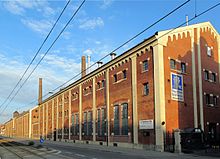
Augustiner brewery in Munich
Also popular, though not from Munich and thus without the right to have a tent at the Oktoberfest, are especially
Tegernseer and
Schneider Weisse, the latter of which has a major beer hall in Munich just as the Munich breweries do. Smaller breweries are becoming more prevalent in Munich, such as
Giesinger Bräu.
[29] However, these breweries do not have tents at Oktoberfest.
Markets[edit]

Viktualienmarkt from above
The
Viktualienmarkt is Munich's most popular market for fresh food and delicatessen. A very old feature of Munich's Fasching (carnival) is the dance of the Marktfrauen (market women) of the Viktualienmarkt in comical costumes.
The
Auer Dult is held three times a year on the square around Mariahilf church and is one of Munich's oldest markets, well known for its hardware, trinkets and antiques.
Three weeks before Christmas, the
Christkindlmarkt opens at Marienplatz and other squares in the city, selling Christmas goods.
Nightlife[edit]

Nightclub in Munich (Harry Klein)
Nightlife in Munich is located mostly in the city centre (
Altstadt-Lehel) and the boroughs
Maxvorstadt,
Ludwigsvorstadt-Isarvorstadt,
Au-Haidhausen and
Schwabing. Between
Sendlinger Tor and
Maximiliansplatz lies the so-called Feierbanane (party banana), a roughly banana-shaped unofficial party zone spanning 1.3 kilometres (0.8 miles) along Sonnenstraße, characterised by a high concentration of clubs, bars and restaurants. In recent years, the Feierbanane has become the mainstream focus of Munich's nightlife and tends to get quite crowded, especially on weekends. It also has sparked some debate among city officials regarding alcohol-related security issues and the party zone's general impact on local residents as well as day-time businesses.
Ludwigsvorstadt-Isarvorstadt's two main quarters, Gärtnerplatzviertel and Glockenbachviertel, are both considered decidedly less mainstream than most other nightlife hotspots in the city and are renowned for their many hip and laid back bars and clubs as well as for being Munich's main centres of gay culture. On warm spring or summer nights, hundreds of young people can be seen gathering at Gärtnerplatz, where they lay down in the grass to relax, talk with friends and drink beer, occupying most of the square's available space in the process.
Maxvorstadt has many smaller bars that are especially popular with university students, whereas
Schwabing, once Munich's first and foremost party district with legendary clubs such as Big Apple, PN, Domicile, Hot Club, Piper Club, Tiffany, Germany's first large-scale disco Blow Up and the underwater nightclub Yellow Submarine as well as many bars such as
Schwabinger 7 or Schwabinger Podium,
[28] has lost much of its nightlife activity in the last decades, mainly due to gentrification and the resulting high rents. It has become the city's most coveted and expensive residential district, attracting affluent citizens with little interest in partying.
Since the mid-1990s, the Kunstpark Ost and its successor Kultfabrik, a former industrial complex that was converted to a large party area near
München Ostbahnhof in
Berg am Laim, hosted more than 30 clubs and was especially popular among younger people and residents of the metropolitan area surrounding Munich.
[30] The Kultfabrik was closed at the end of the year 2015 to convert the area into a residential and office area. Apart from the Kultfarbik and the smaller Optimolwerke, there is a wide variety of establishments in the urban parts of nearby
Haidhausen. Before the Kunstpark Ost, there had already been an accumulation of internationally known nightclubs in the remains of the abandoned former
Munich-Riem Airport.
Munich nightlife tends to change dramatically and quickly. Establishments open and close every year, and some survive only a few months, while others last many years. Beyond the already mentioned venues of the 1960s and 1970s, nightclubs with international recognition in recent history included Tanzlokal Größenwahn, Atomic Cafe, Ultraschall, KW – Das Heizkraftwerk, Natraj Temple and Babalu Bar. From 1995 to 2001, Munich was also home to the
Union Move, one of the largest
technoparades in Germany.
Munich has two directly connected gay quarters, which basically can be seen as one: Gärtnerplatzviertel and Glockenbachviertel, both part of the
Ludwigsvorstadt-Isarvorstadt district.
Freddie Mercury had an apartment near the Gärtnerplatz and transsexual icon
Romy Haag had a club in the city centre for many years.
Munich has more than 100 night clubs and thousands of bars and restaurants within city limits.
[31][32]
Some notable nightclubs are: popular techno clubs are MMA Club (Mixed Munich Arts), Blitz Music Club, Harry Klein, Rote Sonne, Bahnwärter Thiel, Bob Beaman, Pimpernel, Charlie and Palais. Popular mixed music clubs are Call me Drella, Cord, Wannda Circus, Tonhalle and Backstage. High society clubs are the P1 and Pacha Munich. Some notable bars (pubs are located all over the city) are Charles Schumann's Cocktail Bar, Havana Club, Sehnsucht, Bar Centrale, Ksar, Holy Home, Eat the Rich, Negroni, Die Goldene Bar and Bei Otto (a bavarian-style pub).
The
Circus Krone based in Munich is one of the largest circuses in Europe.
[33] It was the first and still is one of only a few in Western Europe to also occupy a
building of its own.
Education[edit]
Colleges and universities[edit]
Munich is a leading location for science and research with a long list of Nobel Prize laureates from
Wilhelm Conrad Röntgen in 1901 to
Theodor Hänsch in 2005. Munich has become a spiritual centre already since the times of Emperor Louis IV when philosophers like
Michael of Cesena,
Marsilius of Padua and
William of Ockham were protected at the emperor's court. The Ludwig Maximilian University (LMU) and the Technische Universität München (TU or TUM), were two of the first three German universities to be awarded the title
elite university by a selection committee composed of academics and members of the Ministries of Education and Research of the Federation and the German states (Länder). Only the two Munich universities and the Technical University of Karlsruhe (now part of
Karlsruhe Institute of Technology) have held this honour, and the implied greater chances of attracting research funds, since the first evaluation round in 2006.
- Ludwig Maximilian University of Munich (LMU), founded in 1472 in Ingolstadt, moved to Munich in 1826
- Technical University of Munich (TUM), founded in 1868
- Akademie der Bildenden Künste München, founded in 1808
- Bundeswehr University Munich, founded in 1973 (located in Neubiberg)
- Deutsche Journalistenschule, founded in 1959
- Bayerische Akademie für Außenwirtschaft, founded in 1989
- Hochschule für Musik und Theater München, founded in 1830
- International Max Planck Research School for Molecular and Cellular Life Sciences
- International School of Management[34]
- Katholische Stiftungsfachhochschule München, founded in 1971
- Munich Business School (MBS), founded in 1991
- Munich Intellectual Property Law Center (MIPLC)
- Munich School of Philosophy, founded in 1925 in Pullach, moved to Munich in 1971
- Munich School of Political Science
- Munich University of Applied Sciences (HM), founded in 1971
- New European College, founded in 2014
- Pionierschule und Fachschule des Heeres für Bautechnik
- Ukrainian Free University, founded in 1921 (from 1945 – in Munich)
- University of Television and Film Munich (Hochschule für Fernsehen und Film), founded in 1966
- Globe Business College Munich
Primary and secondary schools[edit]
Grundschule in Munich:
Gymnasiums in Munich:
Realschule in Munich:
International schools in Munich:
Scientific research institutions[edit]
Max Planck Society[edit]
The
Max Planck Society, an independent German non-profit research organisation, has its administrative headquarters in Munich. The following institutes are located in the Munich area:
- Max Planck Institute for Astrophysics, Garching
- Max Planck Institute of Biochemistry, Martinsried
- Max Planck Institute for Extraterrestrial Physics, Garching
- Max Planck Institute for Foreign and International Social Law, München
- Max Planck Institute for Intellectual Property, Competition and Tax Law, München
- Max Planck Institute of Neurobiology, Martinsried
- Max Planck Institute for Ornithology, Andechs-Erling (Biological Rhythms and Behaviour), Radolfzell, Seewiesen (Reproductive Biology and Behaviour)[35]
- Max Planck Institute for Physics (Werner Heisenberg Institute), München
- Max Planck Institute for Plasma Physics, Garching (also in Greifswald)
- Max Planck Institute of Psychiatry, München
- Max Planck Institute for Psychological Research, München (closed)
- Max Planck Institute of Quantum Optics, Garching
Fraunhofer Society[edit]
The
Fraunhofer Society, the German non-profit research organization for applied research, has its headquarters in Munich. The following institutes are located in the Munich area:
- Applied and Integrated Security – AISEC
- Embedded Systems and Communication - ESK
- Modular Solid-State Technologies - EMFT
- Building Physics – IBP
- Process Engineering and Packaging – IVV
Other research institutes[edit]
Economy[edit]

BMW Headquarters building (one of the few buildings that has been built from the top to the bottom) and the bowl shaped BMW museum
Munich has the strongest economy of any German city
[36] and the lowest unemployment rate (3.0% in June 2014) of any German city of more than a million people (the others being
Berlin,
Hamburg and
Cologne).
[37][38] The city is also the economic centre of
southern Germany. Munich topped the ranking of the magazine
Capital in February 2005 for the economic prospects between 2002 and 2011 in 60 German cities.
Munich is a
financial centre and a
global city and holds the headquarters of
Siemens AG (electronics),
BMW (car),
MAN AG (truck manufacturer, engineering),
Linde (gases),
Allianz (insurance),
Munich Re (
re-insurance), and
Rohde & Schwarz (
electronics). Among German cities with more than 500,000 inhabitants, purchasing power is highest in Munich (€26,648 per inhabitant) as of 2007.
[39] In 2006, Munich blue-collar workers enjoyed an average hourly wage of €18.62 (ca. $20).
[40]
Munich is the largest publishing city in Europe
[43] and home to the
Süddeutsche Zeitung, one of Germany's largest daily newspapers. The city is also the location of the programming headquarters of Germany's largest public broadcasting network,
ARD, while the largest commercial network,
Pro7-Sat1 Media AG, is headquartered in the suburb of
Unterföhring. The headquarters of the German branch of
Random House, the world's largest publishing house, and of
Burda publishing group are also in Munich.
Top 10 largest companies in Munich (2016)[edit]
Transport[edit]
The trade fair
transport logistic is held every two years at the
Neue Messe München (Messe München International).
Munich International Airport[edit]
Other airports[edit]
In 2008, the Bavarian state government granted a license to expand
Oberpfaffenhofen Air Station located west of Munich, for commercial use. These plans were opposed by many residents in the Oberpfaffenhofen area as well as other branches of local Government, including the city of Munich, which took the case to court.
[48] However, in October 2009, the permit allowing up to 9725 business flights per year to depart from or land at Oberpfaffenhofen was confirmed by a regional judge.
[49]
Despite being 110 km (68 mi) from Munich,
Memmingen Airport has been advertised as
Airport Munich West. After 2005, passenger traffic of nearby
Augsburg Airport was relocated to Munich Airport, leaving the Augsburg region of Bavaria without an air passenger airport within close reach.
München Hauptbahnhof[edit]

Munich main railway station
München Hauptbahnhof is the main
railway station located in the city centre. The first Munich station was built about 800 metres to the west in 1839. A station at the current site was opened in 1849 and it has been rebuilt numerous times, including to replace the main station building, which was badly damaged during
World War II.
München Hauptbahnhof is one of the three long distance stations in Munich, the others being
München Ost (to the east) and
München-Pasing (to the west). All three are connected to the public transport system and serve as transportation hubs. München Hauptbahnhof sees about 450,000 passengers a day, which puts it on par with other large stations in Germany, such as
Hamburg Hauptbahnhof and
Frankfurt Hauptbahnhof. It and München Ost are two of the 21 stations in Germany classified by
Deutsche Bahn as a
category 1 station. The mainline station is a
terminal station with 32 platforms. The subterranean
S-Bahn with 2 platforms and
U-Bahn stations with 6 platforms are through stations.
[50][51]
Public transportation[edit]
The extensive network of subway and tram lines assist and complement pedestrian movement in the city centre. The 700m-long Kaufinger Strasse, which starts near the Main train station, forms a pedestrian east-west spine that traverses almost the entire centre. Similarly, Weinstrasse leads off northwards to the Hofgarten. These major spines and many smaller streets cover an extensive area of the centre that can be enjoyed on foot and bike. The transformation of the historic area into a pedestrian priority zone enables and invites walking and biking by making these active modes of transport comfortable, safe and enjoyable. These attributes result from applying the principle of
"filtered permability", which selectively restricts the number of roads that run through the centre. While certain streets are discontinuous for cars, they connect to a network of pedestrian and bike paths, which permeate the entire centre. In addition, these paths go through public squares and open spaces increasing the enjoyment of the trip (see image). The logic of filtering a mode of transport is fully expressed in a comprehensive model for laying out neighbourhoods and districts – the
Fused Grid.
Munich Public Transportation Statistics[edit]
The average amount of time people spend commuting with public transit in Munich, for example to and from work, on a weekday is 56 min. 11% of public transit riders, ride for more than 2 hours every day. The average amount of time people wait at a stop or station for public transit is 10 min, while 6% of riders wait for over 20 minutes on average every day. The average distance people usually ride in a single trip with public transit is 9.2 km, while 21% travel for over 12 km in a single direction.
[52]
Individual transportation[edit]

The Mariensäule (Mary's column)
Traffic, however, is often very heavy in and around Munich. Traffic jams are commonplace during rush hour as well as at the beginning and end of major holidays in Germany. There are few "green waves" or roundabouts, and the city's prosperity often causes an abundance of obstructive construction sites. Other contributing factors are the extraordinarily high rates of car ownership per capita (multiple times that of Berlin), the city's historically grown and largely preserved centralised urban structure, which leads to a very high concentration of traffic in specific areas, and sometimes poor planning (for example bad traffic light synchronisation and a less than ideal ring road).
Cycling[edit]
Cycling has a strong presence in the city and is recognised as a good alternative to motorised transport. The growing number of
bicycle lanes are widely used throughout the year. Munich cyclists have a reputation for being quite daring or even careless, being frequently seen as a nuisance by drivers, especially when their numbers multiply in the warmer months. Cycle paths can be found alongside the majority of sidewalks and streets, although the newer and/or renovated ones are much easier to tell apart from pavements than older ones. The cycle paths usually involve a longer route than by the road, as they are diverted around objects, and the presence of pedestrians can make them quite slow.
A modern
bike hire system is available within the area bounded by the
Mittlerer Ring.
Around Munich[edit]
Nearby towns[edit]
Recreation[edit]
South of Munich, there are numerous nearby freshwater lakes such as
Lake Starnberg,
Ammersee,
Chiemsee,
Walchensee,
Kochelsee,
Tegernsee,
Schliersee,
Simssee,
Staffelsee,
Wörthsee,
Kirchsee and the
Osterseen (Easter Lakes), which are popular among the people of Munich for recreation, swimming and watersports and can be quickly reached by car and a few also by Munich's
S-Bahn.
[53]
International relations[edit]

Plaque in the
Neues Rathaus (New City Hall) showing Munich's twin towns and sister cities
Munich is
twinned with the following cities (date of agreement shown in parentheses).
[54]
Famous people[edit]
Born in Munich[edit]
- Entertainment
- Herbert Achternbusch, born in 1938, film director
- Percy Adlon, born in 1935, film director
- Briana Banks, born in 1978, porn actress
- Moritz Bleibtreu, born in 1971, actor
- Gedeon Burkhard, born in 1969, actor
- Andy Fetscher, born in 1980, film director, cinematographer and screenplay writer
- Therese Giehse, 1898–1975, actress
- Michael Haneke, born in 1942, filmmaker and writer
- Werner Herzog, born in 1942, film director
- Curd Jürgens, 1915–1982, actor
- Max Neal, 1865–1941, dramatist
- Uschi Obermaier, born in 1946, sex symbol of the late sixties
- Lola Randl, born in 1980, film director and screenwriter
- Wolfgang Reitherman, 1909–1985, animator and director of Disney movies
- Jeri Ryan, actress, born in 1968
- Julia Stegner, born in 1984, top model
- Karl Valentin, 1882–1948, comedian, author and film producer
- Fritz Wepper, born in 1941, actor
- Nico Liersch, born in 2000, actor
- Fashion designers
- Musicians
- Lou Bega, born in 1975, singer-songwriter
- Harold Faltermeyer, born in 1952, composer and record producer
- Joey Heindle, born in 1993, DSDS participant in season 9.[60]
- Lubomyr Melnyk, born in 1948, composer and pianist
- Nick Menza, born in 1968, Megadeth drummer
- Brent Mydland, born in 1952, Grateful Dead keyboardist
- Charles Oberthür, 1819–1895, composer
- Carl Orff, 1895–1982, composer
- Wolfgang Sawallisch, 1923–2013, conductor and pianist
- Ralph Siegel, born in 1945, composer
- Sportfreunde Stiller, popular German rock band
- Richard Strauss, 1864–1949, composer
- Nobel Prize laureates
- Eduard Buchner, 1860–1917, chemist and Nobel Prize winner
- Ernst Otto Fischer, 1918–2007, chemist and Nobel Prize winner
- Robert Huber, born in 1937, chemist and Nobel Prize winner
- Wassily Leontief, 1905–1999, economist and Nobel Prize winner
- Feodor Felix Konrad Lynen, 1911–1979, biochemist and Nobel Prize winner
- Rudolf Mössbauer, 1929–2011, physicist and Nobel Prize winner
- Arno Allan Penzias, born in 1933, physicist and Nobel Prize winner
|
- Nobility
- Painters
- Politicians
- Carl Amery, 1922–2005, writer, President of the German PEN Center and founding member of the German Green Party
- Leon Feuchtwanger, 1884–1958, writer
- Heinrich Himmler, 1900–1945, leading member of the Nazi Party, main perpetrator of the Holocaust
- Dr. Carljörg Lacherbauer, 1902–1967, co-founder of Christian Social Union (CSU), Post-war mayor and secretary of the Department of Justice
- Heinrich Müller, 1900–1945, chief of the Gestapo
- Franz Josef Strauss, 1915–1988, Minister-President of the Free State of Bavaria
- Professional Athletes
- Franz Beckenbauer, born in 1945, former footballer and honorary president of Bayern Munich
- Korbinian Holzer, born in 1988, ice hockey player who currently plays in the NHL for the Toronto Maple Leafs
- Fabian Johnson, born in 1987, German born soccer player who plays for Borussia Monchengladbach and the United States National Team
- Philipp Lahm, born in 1983, footballer who played for Bayern Munich
- Christoph Schubert, born in 1982, Ice hockey Player who currently plays in the NHL for the Winnipeg Jets
- Frank Shorter, born 1947, champion distance runner
- Writers
- Lion Feuchtwanger, 1884-1958, writer
- Golo Mann, 1909–1994, writer
- Klaus Mann, 1906–1949, writer
- Eugen Roth, 1895–1976, writer
- Simran Sethi, born in 1970, environmental journalist
- Angie Westhoff, born in 1965, children's author
- Others
- Andreas Baader, 1943–1977, Red Army Faction leader
- Eva Braun, 1912–1945, Adolf Hitler's mistress and later wife
- Adolf Abraham Halevi Fraenkel, 1891–1965, mathematician
- Franz Xaver Gabelsberger, 1789–1849, inventor of the Gabelsberger shorthand writing system
- Jean Baptiste Holzmayer, 1839–1890, teacher, archaeologist and folklorist
- Traudl Humps, 1920–2002, Adolf Hitler's personal secretary during the Second World War
- Dr. E. Lee Spence, born in 1947, pioneer underwater archaeologist and shipwreck historian
|
Notable residents[edit]
- Max Emanuel Ainmiller painter
- Pope Benedict XVI, born Joseph Ratzinger, former Archbishop of Munich-Freising
- Gudrun Burwitz, daughter of Heinrich Himmler
- Manfred Eicher, record producer and founder of ECM Records
- Albert Einstein, 1879–1955, Nobel Prize–winning physicist, grew up in Munich
- Hans Magnus Enzensberger, born 1929, author
- Rainer Werner Fassbinder, 1945–1982, film director
- Roger C. Field, inventor, industrial designer
- Joseph von Fraunhofer, optician
- Asger Hamerik, composer
- Werner Heisenberg, Nobel Prize–winning physicist
- Adolf Hitler, home address is 16, Prinzregentenplatz
- Brigitte Horney, actress (Münchhausen)
- Muhammad Iqbal, Pakistan's national poet, who received his PhD from Munich in 1907
- Wassily Kandinsky, 1866–1944, painter*
- Erich Kästner, author
- Erich Kästner (camera designer), movie camera designer, chief designer at ARRI
- Orlande de Lassus, composer
- Franz von Lenbach, painter
- Vladimir Lenin, Russian revolutionary
- Justus von Liebig, chemist
- Ernst Mach, physicist and philosopher
- Sepp Maier, born 1944, football goalkeeper
- Thomas Mann, 1875–1955, Nobel Prize–winning author
- Helene Mayer, fencer
- Freddie Mercury, lead singer of Queen
|
- Wilhelm Emil "Willy" Messerschmitt, German aircraft designer and manufacturer
- Lola Montez, courtesan to King Ludwig I
- Gerd Müller, born 1945, footballer
- David Dalhoff Neal, painter
- William of Ockham, English medieval philosopher
- Georg Ohm, physicist
- Marsilius of Padua, Italian medieval scholar
- Max Planck, Nobel Prize–winning physicist
- Lucia Popp, Slovak-born opera singer
- Ludwig Prandtl, father of modern aerodynamics
- Max Reger, composer, organist, pianist and conductor
- Wilhelm Röntgen, Nobel Prize–winning physicist
- Willibald Sauerländer, art historian
- Max Schreck, actor
- Arnold Schwarzenegger, former Governor of California, bodybuilder and actor, resided at Christophstr. 1 and worked at Rolf Putziger's gym at Schillerstr. 36 from 1966 to 1968
- Bastian Schweinsteiger, footballer
- Franz von Stuck, painter and sculptor
- Donna Summer, 1948–2012, singer, known as the "Queen of Disco" she was the most successful musical artist of the Disco era in the late 1970s and early 80's
- Vardges Sureniants, Armenian painter
- Fyodor Tyutchev, Russian Romantic poet
- Richard Wagner, 1813–1883, composer
- Heinrich Otto Wieland, Nobel Prize–winning chemist who successfully protected Jewish people
- Stepan Bandera, Ukrainian nationalist, assassinated in October 1959
|
See also[edit]
References[edit]
- Jump up^ "Fortschreibung des Bevölkerungsstandes". Bayerisches Landesamt für Statistik und Datenverarbeitung (in German). January 2018.
- Jump up^ Names of European cities in different languages: M–P#M
- Jump up^ Landeshauptstadt München, Redaktion. "Landeshauptstadt München – Bevölkerung". Landeshauptstadt München. Retrieved 12 February 2016.
- ^ Jump up to:a b "The Munich Metropolitan Region" (in German). Europäische Metropolregion München e.V. Retrieved 17 April 2017.
- Jump up^ "Quality of Living City Rankings". www.imercer.com. Retrieved 31 December 2015.
- Jump up^ "Alpha, Beta and Gamma cities (updated 2015)". Spotted by Locals.
- Jump up^ Englund, Peter (1993). Ofredsår. Stockholm: Atlantis.
- Jump up^ "Munich Travel Tourism Munich". muenchen.de. Retrieved 12 February 2016.
- Jump up^ "Ausländeranteil in der Bevölkerung: In München ist die ganze Welt zu Hause – Abendzeitung München". www.abendzeitung-muenchen.de. Retrieved 31 December 2015.
- Jump up^ "Ausstellung im Foyer". Stmf.bayern.de. Archived from the original on 6 March 2012. Retrieved 25 July 2012.
- Jump up^ [1] Mercer Human Resource Consulting Archived 11 March 2014 at the Wayback Machine.
- Jump up^ 2007 Cost of Living Report Munich Mercer Human Resource Consulting Archived 10 April 2014 at the Wayback Machine.
- Jump up^ "Gesunde Luft für Gesunde Bürger – Stoppt Dieselruß! – Greenpeace misst Feinstaub und Dieselruß in München". Greenpeace-Munich branch. 28 June 2005. Archived from the original on 24 July 2012. Retrieved 25 July 2012.
- Jump up^ "Toytown Germany – English language news and chat". toytowngermany.com.
- Jump up^ "Landeshauptstadt München: Bevölkerungsbestand - Aktuelle Jahreszahlen: Die Bevölkerung in den Stadtbezirken nach ausgewählten Konfessionen am 31.12.2017"(PDF). muenchen.de. Retrieved 2018-03-21.
- Jump up^ "Kartenseite: BRD - Muslime in den Landkreisen beim Zensus 2011" (PDF). kartenseite.wordpress.com. 2017-04-05. Retrieved 2017-04-29.
- Jump up^ "Best 110 historic places worldwide". Traveler.nationalgeographic.com. Retrieved 14 April 2010.
- Jump up^ "Munich in Second Life". Archived from the original on 3 July 2009. Retrieved 18 November 2008.
- Jump up^ "Olympia 2018 in Südkorea, München chancenlos". Die Welt (in German). 6 July 2011. Retrieved 6 July 2011.
- Jump up^ "Munich To Bid Once Again". Games Bids. 27 September 2011. Retrieved 12 April 2016.
- Jump up^ "Public Indoor Swimming Pools in Munich". muenchen.de – The official city portal. Retrieved 6 September 2016.
- Jump up^ "Public Outdoor Swimming Pools in Munich". muenchen.de – The official city portal. Retrieved 6 September 2016.
- Jump up^ "Munich: Swimming pools". Munich City Utilities Company (SWM). Retrieved 5 September 2016.
- Jump up^ "Lakes in Munich" (in German). muenchen.de – The official city portal. Retrieved 6 September 2016.
- Jump up^ Riverbreak Editorial Team. "River Surfing Spots: Eisbach". Riverbreak: The International River Surf Magazine. Retrieved 7 August 2016.
- Jump up^ Toytown Germany. "River surfing in Munich". The Local Europe GmbH. Retrieved 7 August 2016.
- Jump up^ "Museum Reich der Kristalle München". Lrz-muenchen.de. Archived from the originalon 15 April 2009. Retrieved 5 May 2009.
- ^ Jump up to:a b Hecktor, Mirko; von Uslar, Moritz; Smith, Patti; Neumeister, Andreas (1 November 2008). Mjunik Disco – from 1949 to now (in German). ISBN 978-3936738476.
- Jump up^ "Giesinger Bräu München". Giesinger Bräu München (in German). Retrieved 2017-10-25.
- Jump up^ "Corpus Techno: The music of the future will soon be history". MUNICHfound.com. Retrieved 5 February 2017.
- Jump up^ "List of bars in Munich" (in German). muenchen.de – The official city portal. Retrieved 6 September 2016.
- Jump up^ "List of nightclubs in Munich" (in German). muenchen.de – The official city portal. Retrieved 6 September 2016.
- Jump up^ "Circus Krone: Europe's largest traditional circus". Munichfound.com. December 2005. Retrieved 1 May 2013.
- Jump up^ "Management Studium – Private Hochschule – ISM Intern. School of Mgmt". ism.de. Retrieved 12 February 2016.
- Jump up^ "Startseite". mpg.de.
- Jump up^ "Study conducted by INSM (New Social Market Economy Initiative) and WirtschaftsWoche magazine". Icm-muenchen.de. Archived from the original on 19 June 2012. Retrieved 25 July 2012.
- Jump up^ "Statistik der BA". statistik.arbeitsagentur.de. Retrieved 16 July 2014.
- Jump up^ Artikel empfehlen: (27 September 2010). "Endlich amtlich: Köln ist Millionenstadt". Koeln.de. Retrieved 15 September 2011.
- Jump up^ "In Hesse the purchasing power is highest in Germany – CyberPress". Just4business.eu. Retrieved 25 July 2012.
- Jump up^ Landeshauptstadt München, Direktorium, Statistisches Amt: Statistisches Jahrbuch 2007, page 206 (Statistical Yearbook of the City of Munich 2007) http://currency.wiki/18-62eur-usd
- Jump up^ "Global 500 2008: Cities". Money.cnn.com. 21 July 2008. Retrieved 25 July 2012.
- Jump up^ "Insurance - Munich Financial Centre Initiative". www.fpmi.de. Retrieved 2018-02-27.
- Jump up^ "Munich Literature House: About Us". Archived from the original on 4 April 2003. Retrieved 17 February 2008.
- Jump up^ "Bavaria Film GmbH: Company Start". Bavaria-film.de. Archived from the original on 29 May 2012. Retrieved 25 July 2012.
- Jump up^ "Die 10 größten Arbeitgeber in München". Jobs-münchen.com. Retrieved 18 February 2016.
- Jump up^ "Germany to build maglev railway". BBC News. 25 September 2007. Retrieved 7 April 2008.
- Jump up^ "Germany Scraps Transrapid Rail Plans". Deutsche Welle. 27 March 2008. Retrieved 27 March 2008.
- Jump up^ "Flughafen Oberpfaffenhofen: Rolle rückwärts – Bayern – Aktuelles – merkur-online"(in German). Merkur-online.de. Retrieved 25 July 2012.
- Jump up^ Süddeutsche.de GmbH, Munich, Germany. "Flughafen Oberpfaffenhofen – Business-Jets willkommen – München". sueddeutsche.de. Retrieved 25 July 2012.
- Jump up^ "OpenRailwayMap" (Map). Map of München Hauptbahnhof. Cartography by OpenStreetMap. OpenRailwayMap. 28 September 2014. Retrieved 2014-10-19.
- Jump up^ "Lageplan Hauptbahnhof München" (PDF) (orientation map) (in German). Deutsche Bahn AG. 2014. Archived from the original (PDF) on 4 February 2015. Retrieved 19 October 2014.
- Jump up^ "Munich Public Transportation Statistics". Global Public Transit Index by Moovit. Retrieved June 19, 2017.
 Material was copied from this source, which is available under a Creative Commons Attribution 4.0 International License.
- Jump up^ "Lakes in Munich's vicinity" (in German). muenchen.de – The official city portal. Retrieved 6 September 2016.
- Jump up^ "Partnerstädte". Muenchen.de (official website) (in German). Landeshauptstadt München. Retrieved 17 November 2014.
- Jump up^ "Edinburgh – Twin and Partner Cities". 2008 The City of Edinburgh Council, City Chambers, High Street, Edinburgh, EH1 1YJ Scotland. Archived from the original on 28 March 2008. Retrieved 21 December 2008.
- Jump up^ "Twin and Partner Cities". City of Edinburgh Council. Archived from the original on 14 June 2012. Retrieved 16 January 2009.
- Jump up^ "Verona – Gemellaggi" (in Italian). Council of Verona, Italy. Retrieved 3 April 2013.
- Jump up^ "Bordeaux – Rayonnement européen et mondial". Mairie de Bordeaux (in French). Archived from the original on 7 February 2013. Retrieved 29 July 2013.
- Jump up^ "Bordeaux-Atlas français de la coopération décentralisée et des autres actions extérieures". Délégation pour l'Action Extérieure des Collectivités Territoriales (Ministère des Affaires étrangères) (in French). Archived from the original on 7 February 2013. Retrieved 29 July 2013.
- Jump up^ "DSDS 2012: Kandidat Joey Heindle" (in German). RTL. Retrieved 18 April 2012.
External links[edit]
This audio file was created from a revision of the article "
Munich" dated 2014-12-08, and does not reflect subsequent edits to the article. (
Audio help)
- Photos
| [show]
Places adjacent to Munich
|
|---|
| [show]
Cities in Germany by population
|
|---|


.svg)


![[icon]](https://en.wikipedia.org/wiki/File:Wiki_letter_w_cropped.svg)


.svg)


